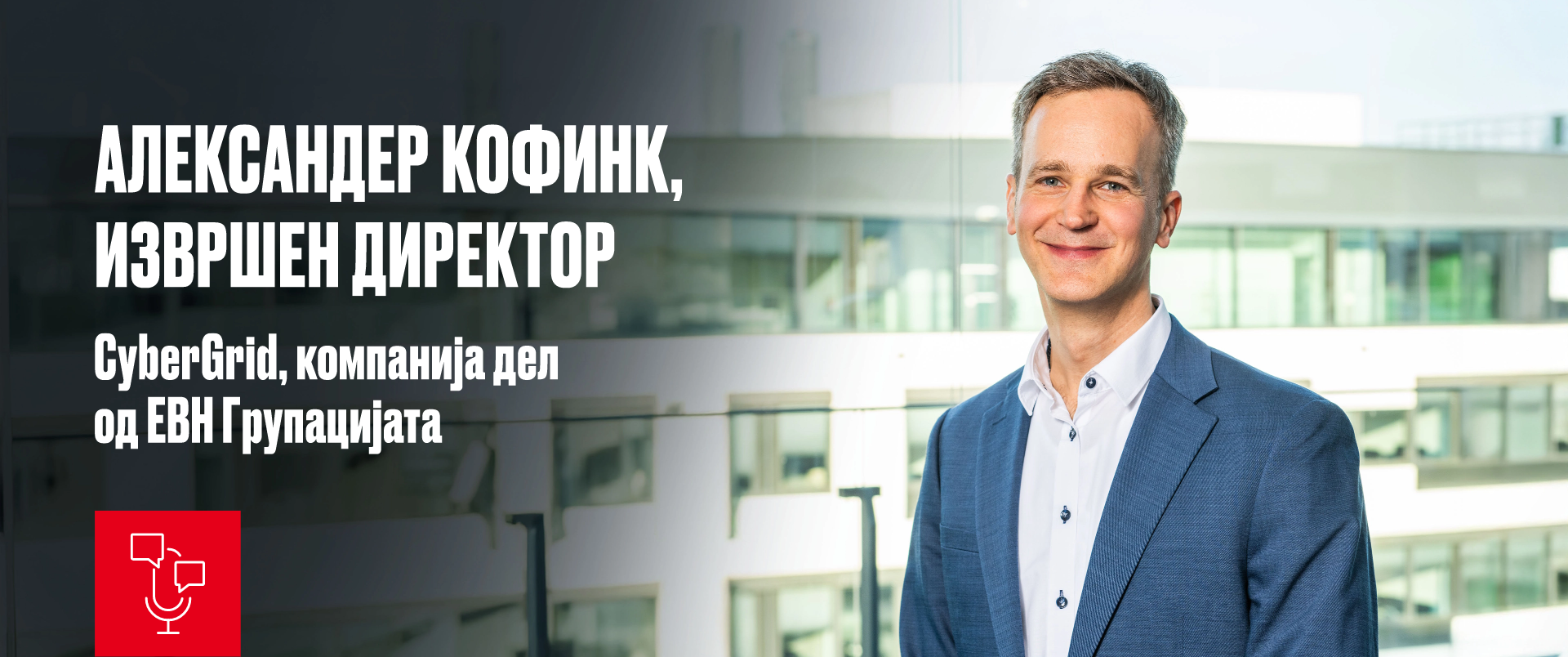
 EVN Supply: Macedonia’s electricity market is evolving rapidly, with increasing renewable energy integration and growing alignment with European market mechanisms. How do you assess the current stage of this transition from your perspective?
Kofink:
EVN Supply: Macedonia’s electricity market is evolving rapidly, with increasing renewable energy integration and growing alignment with European market mechanisms. How do you assess the current stage of this transition from your perspective?
Kofink: Macedonia is at a decisive and very promising stage of its electricity market transition. We see a clear shift from a traditionally centralized system towards a more market-based, flexible, and European-aligned structure, particularly in balancing and short-term markets.
What stands out is that the regulatory framework and the Transmission System Operator (TSO), MEPSO, have already enabled practical market participation for flexible assets. This creates a strong foundation for further integration of variable generation.
From our perspective, the market has moved beyond the conceptual phase. The focus is now on operational excellence: automation, reliable digital interfaces, and the ability to react in real time to system needs. This is exactly the phase where digital flexibility solutions like CyberNoc become essential rather than optional.
EVN Supply: As an electricity supplier operating on the open market, balancing responsibility and portfolio stability are key obligations for us. How can flexibility management and digital solutions support us in managing volatility and system constraints more efficiently?
Kofink: Flexibility management fundamentally changes how suppliers deal with volatility. Instead of reacting to imbalances after they occur, advanced flexibility management technologies allow suppliers to actively manage risk in real time.
Through advanced forecasting, automated dispatch, and continuous portfolio optimization, suppliers can use flexible assets, such as hydropower, batteries, or demand response, to stabilize their balance group. This reduces exposure to imbalance costs and helps manage grid constraints more proactively.
Digital platforms like CyberNoc provide 24/7 automated market access, enabling suppliers to respond instantly to price signals and TSO requests. This turns volatility from a challenge into an opportunity and allows suppliers to operate their portfolios more efficiently, even in increasingly dynamic market conditions.
 EVN Supply: Virtual Power Plants (VPP) are gaining importance across Southeast Europe. How can platforms like CyberNoc help us meet national regulatory requirements while enabling efficient participation in electricity and balancing markets?
Kofink:
EVN Supply: Virtual Power Plants (VPP) are gaining importance across Southeast Europe. How can platforms like CyberNoc help us meet national regulatory requirements while enabling efficient participation in electricity and balancing markets?
Kofink: Virtual Power Plants act as the technical and regulatory bridge between individual assets and the market. Platforms like CyberNoc are designed to comply with national prequalification requirements while simultaneously enabling efficient market participation.
In practice, this means standardized interfaces to the TSO, secure real-time data exchange, and transparent performance monitoring. These elements are critical for meeting regulatory obligations without adding operational complexity for the supplier.
At the same time, a VPP aggregates diverse assets into a single, controllable portfolio. This will become even more relevant with the upcoming regulatory changes in Macedonia. Aggregation increases market relevance, improves bidding quality, and allows suppliers to participate in balancing and short-term markets in a scalable and future-proof way, as markets across Southeast Europe evolve.
 EVN Supply: Battery storage systems are becoming increasingly relevant in the regional market. What concrete value can their integration within a Virtual Power Plant bring for us, particularly in terms of balancing energy, peak management, and price optimization?
Kofink:
EVN Supply: Battery storage systems are becoming increasingly relevant in the regional market. What concrete value can their integration within a Virtual Power Plant bring for us, particularly in terms of balancing energy, peak management, and price optimization?
Kofink: When integrated into a Virtual Power Plant, battery storage systems become highly strategic assets rather than stand-alone technologies. Their fast response times make them ideal for balancing energy, where precision and speed are essential.
Beyond balancing, batteries enable effective peak shaving and peak shifting, helping suppliers reduce exposure during high-price periods and relieve stress on their portfolios. Combined with market price signals, batteries can be charged when prices are low and dispatched when prices rise, supporting systematic price optimization.
Within a VPP, batteries can also be hybridized with renewables or hydropower, allowing coordinated operation across assets. This maximizes overall flexibility value while ensuring that technical constraints such as state-of-charge and asset availability are managed automatically by the platform.
EVN Supply: Looking ahead, how do you see digitalization and flexibility shaping our role as a supplier and contributing to a reliable and sustainable energy system in Macedonia?
Kofink: Digitalization and flexibility will fundamentally redefine the role of suppliers. Suppliers will increasingly act as system integrators, actively supporting grid stability while optimizing their commercial performance.
With higher shares of renewables, system reliability can no longer rely solely on conventional generation. Instead, digitally managed flexibility – from batteries, renewables, and demand-side assets – will become a core pillar of security of supply.
For Macedonia, this means that suppliers who invest early in digital flexibility will be well positioned to support a reliable, resilient, and sustainable energy system, while also unlocking new revenue streams. In this sense, flexibility is not just a technical solution – it is a strategic enabler of the country’s energy transition.